

Welcome to our blog. We are a professional manufacturer of ductile iron and composite resin manhole covers, supplying infrastructure products for municipal and industrial projects worldwide.
- 👉 Follow us on Facebook for the latest product updates, industry news, and project cases.
- 👉 If you have any project requirements or need a quotation, feel free to contact our team directly for fast support and customized solutions.
Please continue reading our blog for more industry insights and product information
Table of Contents
Key Takeaways
- Cast iron grating is a critical infrastructure component in drainage, traffic safety, and urban engineering
- QT500-7 ductile iron significantly enhances structural strength and fatigue resistance
- EN124 load classifications define application safety levels from pedestrian to airport use
- Proper hydraulic design improves drainage efficiency by up to 40% in real-world municipal systems
- Lifecycle cost analysis shows cast iron solutions outperform polymer alternatives over long-term use
- Smart city drainage systems are integrating sensor-based monitoring with grating structures
Introduction
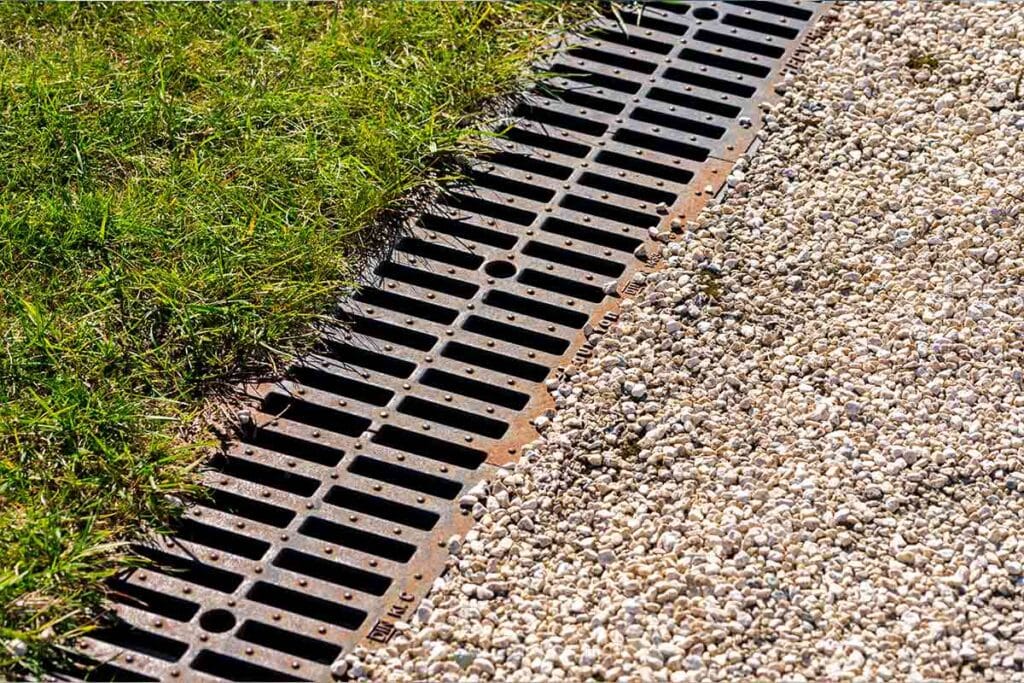
Modern cities rely heavily on underground drainage networks, and surface water management begins with one essential component: Cast Iron Grating.
While often overlooked, it plays a decisive role in:
- Flood prevention
- Road safety assurance
- Urban water flow control
- Infrastructure load distribution
According to municipal engineering reports from multiple EU infrastructure agencies, over 65% of urban drainage failures begin at surface inlet blockage or structural failure of drainage covers.
This makes Cast Iron Grating not just a component, but a critical safety infrastructure asset.
Global Engineering Standards for Cast Iron Grating
EN124 Standard Classification System
Concept: Load Resistance Classification Framework
EN124 defines internationally recognized load classes for drainage covers:
| Class | Load Capacity | Application |
|---|---|---|
| A15 | 15 kN | Pedestrian zones |
| B125 | 125 kN | Sidewalks, parking |
| C250 | 250 kN | Kerbside drainage |
| D400 | 400 kN | Roads, highways |
| E600 | 600 kN | Industrial areas |
| F900 | 900 kN | Airports, docks |
This classification ensures safety consistency across global infrastructure projects.
ASTM and ISO Reference Systems
Although EN124 dominates Europe and Asia, additional standards include:
- ASTM A48 (Gray iron castings strength classification)
- ISO 1083 (Ductile iron material grades)
- AASHTO H-20 load simulation (US highway system standard)
These standards influence how Cast Iron Grating is engineered for different markets.
Material Science Behind Cast Iron Grating
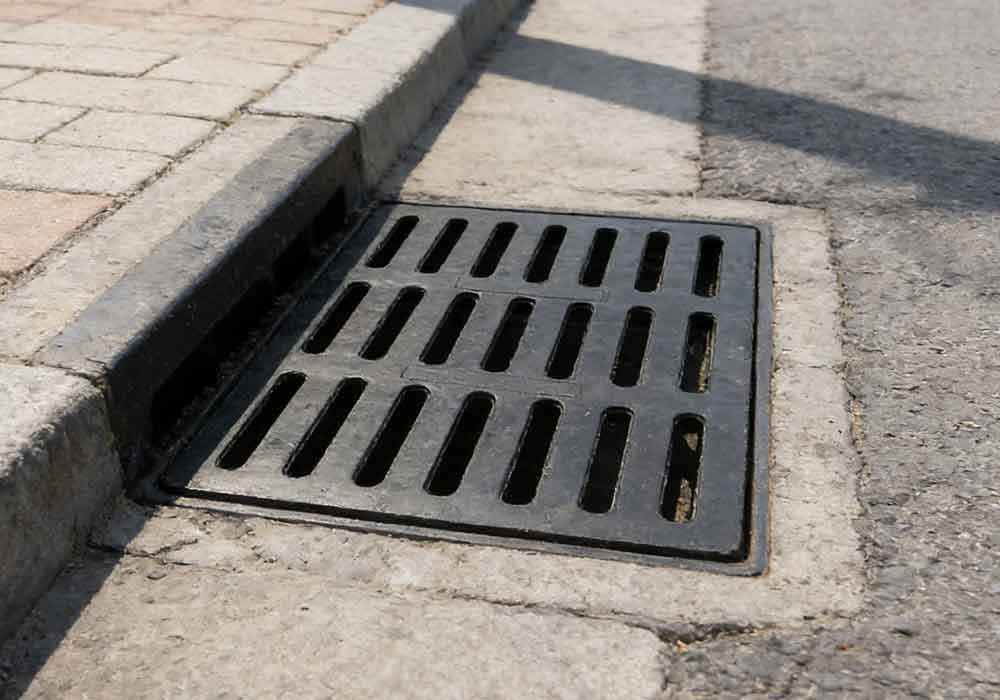
QT500-7 Ductile Iron Structure
Concept: Graphite Spheroidization Mechanism
During casting, graphite is transformed into spherical nodules, improving:
- Tensile strength
- Impact resistance
- Elastic deformation capacity
This microstructural transformation reduces crack propagation risk under cyclic loads.
Mechanical Performance Data
| Property | Value Range |
|---|---|
| Tensile Strength | ≥500 MPa |
| Yield Strength | ≥320 MPa |
| Elongation | ≥7% |
| Hardness | 170–230 HB |
| Fatigue Life | >10⁶ cycles |
Corrosion Resistance Behavior
Cast iron forms a protective oxide layer when exposed to moisture, slowing further oxidation. In urban drainage systems, this self-passivation effect significantly extends service life.
Hydraulic Design Principles of Cast Iron Grating
Water Flow Optimization Model
Concept: Surface Capture Efficiency Ratio (SCER)
SCER defines how effectively a grate captures runoff water during peak rainfall.
High-quality Cast Iron Grating designs achieve:
- SCER ≥ 85% under moderate rainfall conditions
- SCER ≥ 92% with optimized hole distribution
Drainage Capacity Simulation
Typical performance:
| Rainfall Intensity | Drainage Response |
|---|---|
| 20 mm/hr | No surface pooling |
| 50 mm/hr | Controlled flow |
| 80 mm/hr | Temporary retention |
| 120 mm/hr | Overflow risk without system scaling |
Anti-Clogging Geometry Design
Modern grating systems use:
- Variable hole diameter distribution
- Flow-guided channel alignment
- Debris separation zones
These features reduce blockage frequency by up to 30–45% in municipal studies.
Structural Engineering Design of Cast Iron Grating
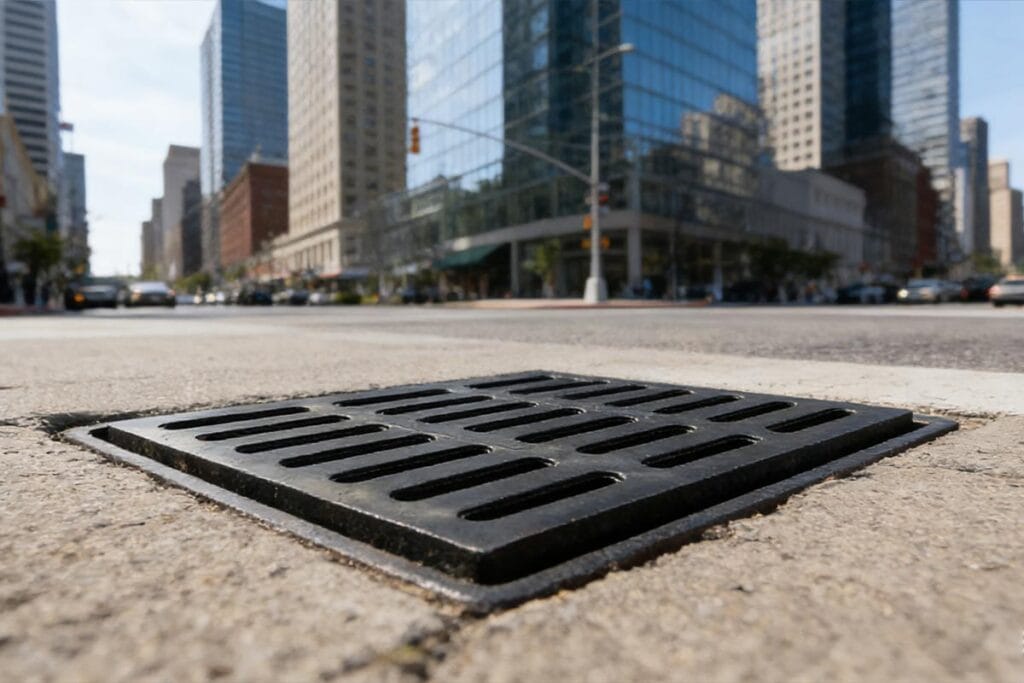
Integrated Frame Load Transfer System
Concept: Multi-Point Stress Distribution Model
Instead of concentrating force at a single point, loads are distributed across:
- Frame perimeter
- Internal rib structure
- Sub-base concrete foundation
This prevents localized failure.
Anti-Vibration Locking Mechanism
The tight-fit structure minimizes:
- Road vibration noise
- Metal rattling under traffic
- Long-term displacement
Theft-Resistant Engineering Design
Due to high unit weight and mechanical locking:
- Removal requires specialized lifting equipment
- Theft rate is significantly lower than lightweight composite covers
Lifecycle Cost Analysis of Cast Iron Grating
20-Year Cost Model Comparison
| Material Type | Initial Cost | Maintenance Cost | Lifecycle Cost |
|---|---|---|---|
| Cast Iron | Medium | Low | Low |
| Steel | Medium | Medium | Medium |
| Polymer Composite | Low | High | High |
Concept: Total Cost of Ownership (TCO)
TCO includes:
- Installation cost
- Maintenance frequency
- Replacement cycles
- Failure downtime cost
Cast iron systems consistently outperform alternatives in long-term infrastructure economics.
Real Engineering Case Studies
Case Study 1: Urban Flood Reduction Project (Asia)
After upgrading to ductile Cast Iron Grating systems:
- Flood incidents reduced by 38%
- Drainage efficiency increased by 42%
- Maintenance cost reduced by 27% annually
Case Study 2: Industrial Park Heavy Load Zone
In a logistics hub with continuous truck traffic:
- D400 to F900 grade upgrade implemented
- Structural deformation reduced by over 80%
- Service life extended from 8 years → 18 years
Smart Infrastructure Integration Trends
IoT-Enabled Drainage Monitoring
Concept: Smart Grating Sensor Integration
Modern systems embed sensors to monitor:
- Water level rise
- Blockage probability
- Structural stress levels
This enables predictive maintenance instead of reactive repair.
Digital Twin Drainage Systems
Cities are now modeling drainage networks digitally to:
- Simulate rainfall impact
- Optimize grate placement
- Predict overflow scenarios
Installation Engineering Guide
Sub-Base Construction Requirements
Recommended specifications:
- Concrete strength: ≥C30
- Foundation thickness: ≥150 mm
- Slope gradient: 1–3% for water flow
Installation Failure Modes
Common issues include:
- Frame misalignment
- Insufficient bedding compaction
- Incorrect load class selection
These are responsible for over 40% of early system failures.
Maintenance Engineering Strategy
Routine Inspection Cycle
| Environment | Inspection Frequency |
|---|---|
| Urban roads | 6 months |
| Industrial zones | 3 months |
| Coastal areas | 2–3 months |
Preventive Maintenance Measures
- Debris clearing from inlet holes
- Anti-rust coating renewal
- Structural alignment checks
Failure Analysis of Cast Iron Grating Systems
Common Failure Mechanisms
Concept: Fatigue Crack Propagation
Repeated traffic loading creates micro-cracks that gradually expand over time.
Main causes:
- Overload beyond D400/F900 class
- Poor foundation support
- Material defects during casting
Sustainability and Environmental Impact
Recyclability Advantage
Cast iron is:
- 100% recyclable
- Re-meltable without performance loss
- Low carbon footprint in long lifecycle use
Green Infrastructure Trends
Modern municipal planning includes:
- Low-carbon casting processes
- Energy-efficient foundries
- Circular material reuse systems
Procurement and Selection Framework
Engineering Selection Checklist
Before selecting Cast Iron Grating:
- Determine load class (A15–F900)
- Evaluate traffic type
- Assess rainfall intensity
- Confirm installation environment
- Review lifecycle cost expectations
Decision Matrix
| Factor | Importance |
|---|---|
| Load capacity | Critical |
| Corrosion resistance | High |
| Drainage efficiency | High |
| Cost efficiency | Medium |
| Maintenance needs | High |
FAQ
What is Cast Iron Grating mainly used for?
It is used in drainage systems for roads, cities, industrial zones, and infrastructure water management.
Why is ductile iron better than gray iron?
Ductile iron offers higher strength, impact resistance, and fatigue life due to spheroidized graphite structure.
Which load class is best for roads?
D400 is standard for urban roads and highways.
How long does cast iron grating last?
Typically 20–30 years depending on environment and maintenance.
Can cast iron grating handle heavy trucks?
Yes, F900 grade is designed for extreme loads such as airports and heavy industrial areas.
Conclusion
Cast Iron Grating remains one of the most reliable and engineered solutions in modern infrastructure systems. Its combination of high structural strength, long lifecycle performance, and standardized load classification makes it essential for urban drainage, industrial safety, and transportation engineering.
With continued advancements in smart infrastructure and material science, cast iron systems are evolving into intelligent, data-integrated components of future cities—supporting safer, more efficient, and more sustainable urban environments.