

Come to our blog. We are a professional manufacturer of ductile iron and composite resin manhole covers, supplying infrastructure products for municipal and industrial projects worldwide.
- 👉 Follow us on Facebook for the latest product updates, industry news, and project cases.
- 👉 If you have any project requirements or need a quotation, feel free to contact our team directly for fast support and customized solutions.
Please continue reading our blog for more industry insights and product information
Table of Contents
Choosing the right cast iron drain grates is not simply a matter of finding a grate that fits the opening.
For municipal roads, industrial parks, commercial developments, ports, parking areas, and stormwater drainage systems, the grate must work as part of a complete drainage structure. Load class, material, clear opening, frame support, slot geometry, waterway area, traffic direction, coating, and installation conditions can all affect long-term performance.
A grate that looks strong may still fail prematurely if it is installed in the wrong traffic environment or paired with an incompatible frame. Likewise, choosing the heaviest product available does not automatically provide the best load-bearing performance.
This 2026 buyer’s guide explains the most important factors engineers, contractors, distributors, importers, and infrastructure buyers should evaluate before ordering cast iron drainage grates.
For available drainage products and customized specifications, buyers can first review the Shengxin Foundry product range.
Quick Answer: How Do You Choose Cast Iron Drain Grates?
The right cast iron drain grate should be selected according to:
- installation location;
- expected vehicle and pedestrian traffic;
- required load class;
- clear drainage opening;
- grate and frame dimensions;
- material grade;
- slot size and orientation;
- drainage or waterway area;
- frame support;
- locking or anti-movement requirements;
- corrosion exposure;
- applicable project standards.
For most engineering projects, load class and installation position should be determined before dimensions, weight, or price are compared.
A road drainage grate and a pedestrian-area grate may look similar, but their structural requirements can be completely different.
What Is a Cast Iron Drain Grate?
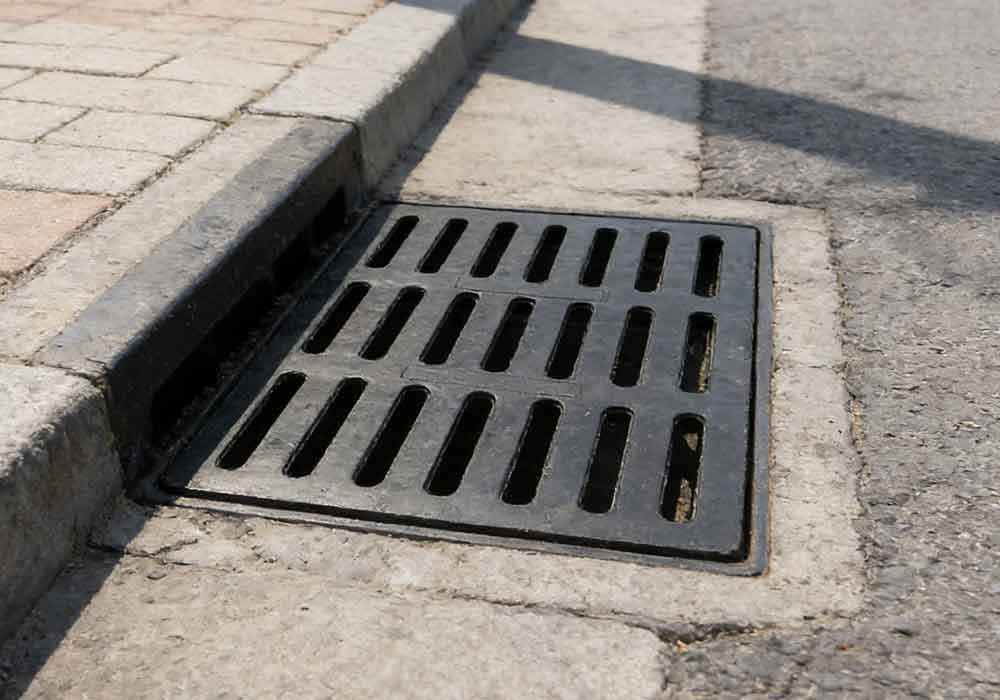
A cast iron drain grate is a load-bearing drainage component installed over a drainage channel, catch basin, gully, trench, or stormwater inlet.
Its two main functions are to:
- allow surface water to enter the drainage system efficiently; and
- safely support pedestrian or vehicle loads above the drainage opening.
Unlike a solid manhole cover, a drain grate contains openings or slots that allow water to pass through.
Depending on the project, cast iron drain grates may be installed in:
- municipal roads;
- road shoulders;
- curbside drainage systems;
- parking areas;
- commercial developments;
- industrial parks;
- factories;
- logistics centers;
- ports and terminals;
- residential communities;
- public squares;
- stormwater drainage networks.
Shengxin Foundry supplies cast iron drainage products for municipal, industrial and infrastructure applications through its manhole cover and drainage product center.
Why Is Ductile Iron Commonly Used for Drain Grates?
Modern heavy-duty drainage grates are often manufactured from ductile iron rather than relying only on traditional gray cast iron.
Ductile iron contains graphite in a spheroidal or nodular form, giving the material a useful combination of strength, toughness, and casting capability.
For infrastructure buyers, this can provide several practical advantages.
Higher Structural Reliability
Drain grates repeatedly experience concentrated loads from wheels, trucks, forklifts, and other traffic.
A well-designed ductile iron grate can distribute these loads through its rib structure and frame rather than relying solely on product thickness or weight.
Good Casting Flexibility
Casting allows manufacturers to produce:
- structural reinforcing ribs;
- drainage slots;
- anti-slip textures;
- identification marks;
- customized logos;
- locking structures;
- shaped frame interfaces.
This makes cast iron grates suitable for both standardized infrastructure projects and customized OEM requirements.
Suitable for Heavy-Duty Applications
Depending on product design and verified load performance, ductile iron drainage grates can be engineered for demanding road and industrial environments.
However, buyers should never assume that material alone determines the load class. Structural design, frame geometry, clear span, manufacturing quality, testing, and installation all matter.
Understanding Cast Iron Drain Grate Load Classes
One of the most important purchasing decisions is determining the required load class.
For projects following European requirements, EN 124 is a major reference for gully tops and manhole tops used in pedestrian and vehicular areas.
The British Standards Institution explains that BS EN 124-1:2015 covers classification, design principles, performance requirements and testing for these products.
Typical classifications include:
| Load Class | Nominal Test Load | Typical Application |
|---|---|---|
| A15 | 15 kN | Pedestrian and cyclist-only areas |
| B125 | 125 kN | Footways, pedestrian zones, some parking areas |
| C250 | 250 kN | Kerbside and channel drainage areas |
| D400 | 400 kN | Road carriageways and vehicle traffic areas |
| E600 | 600 kN | Heavy industrial environments |
| F900 | 900 kN | Extremely heavy-load environments |
These categories should be treated as selection guidance rather than a substitute for the project’s engineering specification.
BSI product certification records, for example, include B125, C250 and D400 grating systems manufactured for different installation conditions, illustrating why the installation area and required classification need to be matched carefully.
Is D400 Always the Best Choice for Roads?
Not necessarily.
D400 is commonly associated with carriageways carrying road vehicles, but specifying a higher class does not automatically make it the best product for every drainage location.
The correct selection depends on:
- exact installation position;
- wheel-loading conditions;
- traffic frequency;
- heavy vehicle percentage;
- frame support;
- local regulations;
- project specification;
- installation environment.
For a deeper explanation of procurement errors related to load selection, see Shengxin Foundry’s guide to cast iron grate buying mistakes.
Do Not Select a Drain Grate by Weight Alone
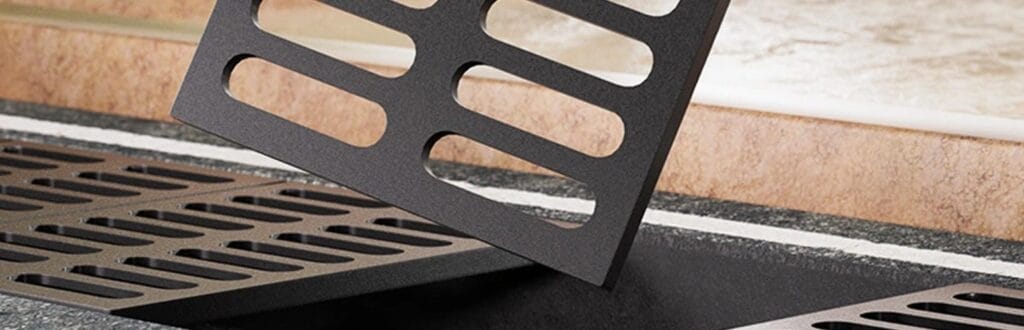
This is one of the most common mistakes in international purchasing.
Buyers sometimes compare two cast iron drain grates and assume:
heavier grate = stronger grate.
That conclusion can be misleading.
Grate performance also depends on:
- ductile iron grade;
- rib thickness;
- rib depth;
- rib arrangement;
- unsupported span;
- bearing area;
- frame geometry;
- casting consistency;
- structural design;
- load testing.
Two grates with similar dimensions and almost identical weights can have very different load performance.
A properly engineered rib structure may use material more efficiently than an unnecessarily heavy design.
Therefore, when evaluating quotations, request the technical drawing and applicable load information, not simply the total product weight.
How to Choose the Correct Drain Grate Size
“600 × 600 mm” is not enough information for a professional drainage grate order.
Buyers should distinguish between several dimensions.
Clear Opening
The clear opening is the actual unobstructed drainage opening below the grate.
It affects both hydraulic capacity and structural span.
Overall Grate Size
This is the external size of the removable grate.
It must match the frame’s seating dimensions.
Frame Size
The outside dimensions of the complete frame determine how it fits into the surrounding concrete, channel, or drainage structure.
Frame Depth
Frame depth can influence:
- installation stability;
- load distribution;
- compatibility with surrounding pavement;
- replacement feasibility.
Bearing Surface
The grate must sit correctly on the frame.
Insufficient bearing area, poor seating, excessive clearance, or dimensional mismatch may result in movement, vibration, noise, impact loading, and premature wear.
Why the Grate and Frame Should Be Selected Together
For new construction, the safest approach is usually to specify the grate and frame as one engineered assembly.
Replacing only the grate can create compatibility problems if the existing frame is:
- worn;
- distorted;
- cracked;
- corroded;
- improperly supported;
- dimensionally different;
- no longer level.
A small mismatch can cause the grate to rock under traffic.
Repeated rocking creates impact rather than stable static loading, which may accelerate damage to the grate, frame and surrounding pavement.
For existing systems, Shengxin’s FAQ and installation guidance also emphasizes the importance of stable, level support and correct positioning.
Drainage Capacity Matters as Much as Strength
A drain grate must support traffic, but it must also drain water.
This creates an engineering balance.
If openings are too small, the grate may restrict inflow.
If openings are too large, the design may introduce pedestrian, bicycle, debris, or safety concerns.
Important hydraulic factors include:
- total open area;
- number of slots;
- slot width;
- slot length;
- slot orientation;
- clear opening below the grate;
- expected rainfall;
- approach flow;
- debris exposure;
- drainage channel capacity.
BS EN 124-1 addresses grate slot dimensions and waterway considerations as part of gully-top design, reinforcing that drainage openings are functional engineering features rather than merely decorative patterns.
Slot Orientation Can Affect Safety and Performance
Slot direction deserves more attention than it usually receives during purchasing.
For roadway and cycling environments, slot geometry should be evaluated in relation to the expected direction of traffic.
Why?
Because poorly selected opening orientation can affect:
- bicycle-wheel safety;
- pedestrian comfort;
- water capture;
- debris retention;
- structural rib arrangement.
This is especially important for municipal projects where pedestrians, bicycles and vehicles may all pass over or beside the drainage grate.
Buyers should provide the supplier with the expected traffic direction whenever grate orientation is project-specific.
Cast Iron Drain Grates by Application
Different environments require different priorities.
Municipal Roads
Road projects generally prioritize:
- verified load performance;
- stable grate-to-frame seating;
- anti-slip surface design;
- efficient stormwater intake;
- resistance to movement;
- durable coating.
Heavy traffic roads may also benefit from locking or securing systems where specified.
Industrial Parks
Industrial environments may expose drain grates to:
- heavy trucks;
- forklifts;
- repeated loading;
- oils;
- dust;
- industrial debris.
In these projects, buyers should evaluate both load class and maintenance access.
Parking Areas
Parking facilities experience lower speeds than major roads but may still receive repeated wheel loads.
The correct product depends on vehicle type, expected traffic and installation position.
Ports and Logistics Terminals
Ports and logistics facilities can create particularly demanding loading environments due to:
- container vehicles;
- trailers;
- heavy handling equipment;
- concentrated wheel loads;
- coastal humidity;
- salt exposure.
These projects should be evaluated individually rather than using a standard municipal-road specification automatically.
Residential and Commercial Areas
Here, buyers may place more emphasis on:
- pedestrian safety;
- appearance;
- noise reduction;
- anti-slip surfaces;
- manageable maintenance;
- sufficient drainage capacity.
What Surface Features Should Buyers Check?
A drain grate’s surface is not merely cosmetic.
Anti-Slip Texture
Raised textures can help improve traction in wet conditions.
This is particularly important around:
- roads;
- pedestrian areas;
- loading zones;
- commercial developments.
Coating
Cast iron products commonly receive protective surface treatments.
The appropriate coating depends on project requirements, shipping conditions and exposure environment.
Coating should not be used to hide casting defects. Buyers should evaluate the casting quality itself.
Markings
Depending on project and market requirements, markings may include:
- load class;
- standard reference;
- manufacturer identification;
- project name;
- municipal logo;
- utility identification;
- customer branding.
Shengxin supports customized size, specifications, branding and appearance for infrastructure applications, as described in its customizable product solutions.
Common Cast Iron Drain Grate Buying Mistakes
1. Buying Only by Price
A small initial saving can become expensive if unsuitable grates require early replacement.
Evaluate lifecycle value, not only unit price.
2. Assuming Heavier Means Stronger
Weight alone does not confirm structural performance.
3. Ignoring the Frame
A high-quality grate installed on a weak or incompatible frame may still fail.
4. Selecting the Wrong Load Class
Under-specification creates safety risk, while unnecessary over-specification can increase project cost.
5. Providing Only Outside Dimensions
Clear opening, frame depth and seating dimensions may also be required.
6. Ignoring Drainage Area
A strong grate that restricts stormwater flow is still the wrong product.
7. Failing to Define the Application
“Drain grate required” is not an adequate engineering specification.
Tell the supplier exactly where the product will be installed.
What Information Should You Send a Manufacturer?
For faster and more accurate quotations, prepare the following information.
| Information | Why It Matters |
| Project location | Helps identify environmental conditions |
| Application | Road, parking area, industrial park, port, etc. |
| Required standard | Determines testing/specification basis |
| Load class | Defines structural requirement |
| Clear opening | Determines system geometry |
| Grate dimensions | Ensures dimensional compatibility |
| Frame dimensions | Helps confirm complete assembly |
| Frame depth | Important for installation |
| Material requirement | Confirms casting specification |
| Slot/opening requirements | Affects drainage and safety |
| Locking requirement | Important in some public projects |
| Surface/coating | Depends on environmental requirements |
| Logo/marking | Relevant for OEM or municipal projects |
| Quantity | Influences manufacturing and quotation |
| Drawings/photos | Essential for custom or replacement work |
| Destination port | Required for logistics estimation |
If an existing drain grate must be replaced, photographs and dimensioned drawings are particularly valuable.
Cast Iron vs Composite Drain Grates
Cast iron is not the only drainage material available.
The right choice depends on the application.
| Factor | Cast Iron | Composite |
| Heavy-load applications | Excellent when properly engineered | Depends strongly on design/class |
| Product weight | Higher | Generally lower |
| Corrosion behavior | Usually requires appropriate protection | Naturally resistant to many corrosion conditions |
| Scrap value | Has metal value | Low scrap value |
| Custom surface design | Good | Good |
| Handling | Heavier | Easier |
| Typical use | Roads, industrial and infrastructure projects | Residential, municipal and special corrosion-sensitive applications |
Rather than asking which material is “best,” buyers should ask:
Which material provides the required performance for this exact installation environment?
Shengxin Foundry supplies both ductile iron and composite infrastructure products, allowing buyers to review alternatives through the company’s complete drainage and manhole cover range.
How to Evaluate a Cast Iron Drain Grate Supplier

Product specifications matter, but supplier capability matters too.
Before a large infrastructure order, evaluate:
Manufacturing Capability
Can the factory consistently produce the required volume and dimensions?
Shengxin states that its ductile iron and composite facilities support an annual production capacity of approximately 21,000 tons for multi-specification and large-volume orders.
Customization Capability
For international projects, customization may include:
- dimensions;
- load requirements;
- surface patterns;
- logos;
- colors;
- casting marks;
- frame structures.
Quality Control
Ask how the manufacturer controls:
- raw materials;
- casting;
- dimensions;
- surface quality;
- finished products;
- load performance where applicable.
Export Experience
International buyers should also evaluate:
- packaging;
- container loading;
- documentation;
- export experience;
- logistics coordination.
Technical Communication
A good supplier should ask questions before manufacturing.
If a manufacturer accepts a large custom order without asking about load class, application, dimensions or standards, that may indicate insufficient technical review.
Buyer’s Pre-Order Checklist
Before approving your cast iron drain grate order, confirm:
- Installation location is defined
- Traffic type is known
- Required load class is confirmed
- Applicable standard is confirmed
- Clear opening is measured
- Grate dimensions are confirmed
- Frame dimensions are confirmed
- Frame depth is confirmed
- Material requirement is specified
- Drainage opening requirements are reviewed
- Slot orientation is appropriate
- Locking requirements are confirmed
- Surface coating is specified
- Required markings or logos are confirmed
- Technical drawings have been approved
- Quantity and packing requirements are confirmed
This checklist is particularly valuable for custom infrastructure orders because dimensional mistakes are far more expensive to correct after casting and international shipment.
Frequently Asked Questions
What is the best material for a drain grate?
There is no single best material for every project. Ductile iron is widely used where high structural strength and durable load-bearing performance are required, while composite materials may be advantageous where low weight or corrosion resistance is a priority.
Are cast iron drain grates suitable for roads?
Yes, provided the grate and frame are designed, tested, specified and installed for the required road loading and applicable project standard.
Is D400 suitable for road traffic?
D400 is commonly specified for carriageway applications under EN 124-based classification systems. However, the final specification should always follow the project’s installation location, traffic conditions, engineering requirements and local regulations.
How thick should a cast iron drain grate be?
There is no universal correct thickness. Load capacity depends on the complete structural design, including rib geometry, material, clear span and frame support. Thickness alone should not be used as the purchasing specification.
Is a heavier cast iron grate better?
Not necessarily. A heavier product may contain more iron, but structural efficiency, rib design, material properties, frame support and verified performance matter more than weight alone.
Can cast iron drain grates be customized?
Yes. Depending on tooling and manufacturing requirements, dimensions, patterns, logos, markings, frame structures and other features can be customized. Shengxin Foundry provides OEM/ODM options for international and infrastructure buyers.
Can I replace only the grate and keep the old frame?
Possibly, but only after the existing frame has been inspected for dimensions, damage, deformation, support and compatibility. For new construction, specifying the grate and frame as a complete system is usually more reliable.
What details are needed for a drain grate quotation?
At minimum, provide the application, required load class, clear opening, grate size, frame dimensions, material requirement, quantity and delivery destination. Drawings and photographs are highly recommended for customized or replacement projects.
Final Thoughts
The best cast iron drain grates are not necessarily the heaviest, thickest or cheapest products.
They are the products correctly matched to the engineering conditions of the project.
A professional specification should connect:
application → traffic → load class → dimensions → material → drainage capacity → frame design → installation.
Getting these factors right before production can reduce fitting problems, premature failure, site modifications, replacement costs and drainage performance issues.
For contractors, importers, distributors and municipal infrastructure buyers sourcing customized cast iron drainage products, Shengxin Foundry provides ductile iron drainage products, manhole covers and related infrastructure components for international projects.
Browse the Shengxin Foundry product range, review common technical questions in the FAQ center, or contact the Shengxin team with your drawings, required load class, dimensions, quantity and destination to discuss a project-specific solution.
Need a quotation for cast iron drain grates?
Send your required dimensions, load class, quantity, drawings and project application to Shengxin Foundry for specification review and customized manufacturing support.