

Table of Contents
Storm drain basket mesh openings define one part of a litter-capture system, but a smaller opening is not automatically a better choice. Finer geometry can change what is retained, where debris bridges and how often the operator needs access. Larger openings may pass material the project intended to intercept. The useful decision begins with the debris target and the inlet's hydraulic role. This guide shows how to compare mesh proposals as complete installed baskets, preserving both capture objectives and drainage requirements without presenting an unspecified screen as a treatment system for every pollutant.
Write a target-material statement before selecting aperture
Describe the debris the project is intended to intercept using catchment observations. Leaves, flexible packaging, coarse fragments and fine deposits do not behave identically at an opening. Record why those materials matter to the owner and where they originate. Avoid beginning with the smallest mesh in a supplier's list and assuming that more retention always serves the drainage objective. A basket chosen for coarse litter should not be described as removing dissolved substances or every fine particle carried by runoff.
Keep the target statement bounded. If the owner needs a measured capture performance, define the relevant material and assessment basis with the responsible specialist. A visual description such as fine filtration does not provide a measurable acceptance requirement. Identify which outcomes are established by geometry and which need performance evidence. This prevents a nominal aperture dimension from becoming an unsupported promise about water quality or downstream maintenance savings.
Define the actual clear openings in the offered construction
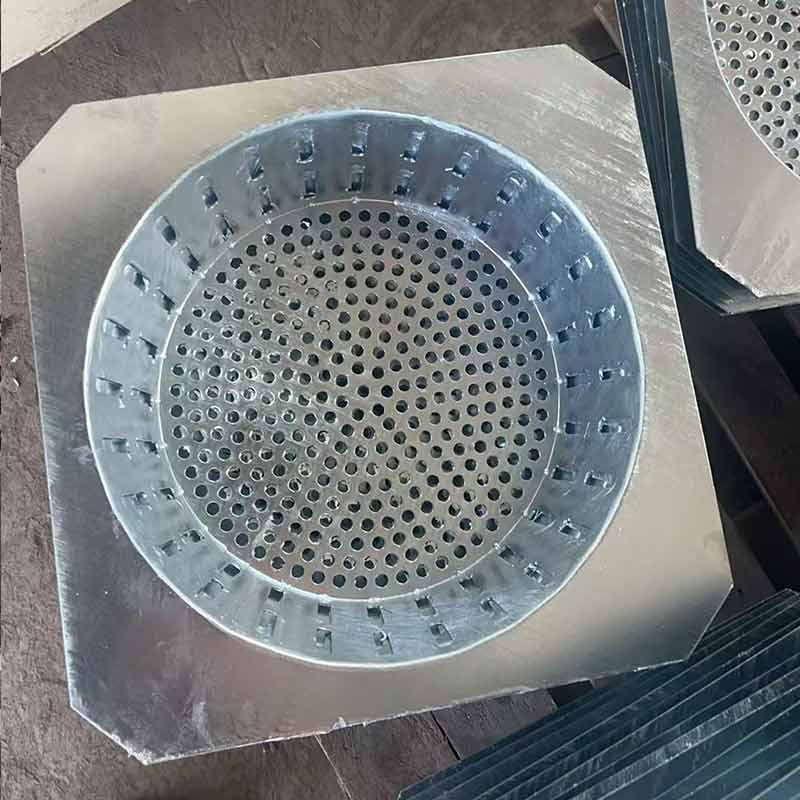
Ask whether the basket uses woven mesh, expanded material, perforated sheet or another construction. Request clear-opening dimensions, shape and supporting details for the exact model. Nominal mesh count or a trade label may not describe the free passage the buyer assumes. Show seams, edge closures and support members as well as the main panel. Material can escape through a perimeter gap even when every main opening matches the specification.
Review how openings are measured and what production variation is permitted. A photograph taken at an angle is not a dimensional verification. Where the project specifies a limiting aperture, agree an appropriate inspection method and tolerances through the responsible design and supplier review. Do not invent a universal mesh tolerance. Keep the construction reference with the dimension so an alternative woven or perforated product cannot be substituted on an unexplained claim that the nominal size is the same.
Consider how deformable debris meets the opening
Flexible material can fold, bridge or blanket a screen in ways that a rigid dimensioned object does not. Leaves can overlap and packaging can drape across several openings. These observations explain why aperture alone cannot predict field capture or blockage. Use them to define relevant evidence and maintenance scenarios, without assigning an exact efficiency from appearance. The owner needs to know what the proposed geometry can reasonably be assessed to do with the actual debris.
If the supplier offers capture testing, inspect the tested material, loading and basket configuration. Confirm that the mesh, seams, supports and perimeter arrangement represent the proposal. A result for a flat panel may inform one question while leaving the installed basket's bypass and accumulation behaviour unresolved. Record those limits. The project should not borrow a headline percentage from a test whose challenge material or flow arrangement differs materially from its intended use.
Assess hydraulic resistance as material accumulates
Provide the drainage designer with the complete installed section and proposed mesh layout. Identify the sides, base and other areas through which water is expected to pass. Accumulation may obstruct one region before the basket's geometric volume is occupied. The assessment should consider plausible loading patterns and any adopted obstruction assumptions under the applicable design criteria. Do not substitute a universal full-basket condition for that project review.
Keep the downstream system in view. A basket above a constrained outlet cannot be assessed solely by its clean-screen area. Ask how the inlet conveys water through and around the insert and what happens as the available passage changes. The supplier's geometry and relevant test data support the review; they do not establish catchment adequacy from one product image. Record the conditions and uncertainty so purchasing does not turn an estimate into an unconditional capacity claim.
| Comparison factor | Evidence to request | Decision it informs |
|---|---|---|
| Target debris | Catchment observations and bounded capture objective | Whether the proposed aperture addresses the actual material |
| Opening construction | Clear dimensions, shape and edge details | Whether alternatives are geometrically comparable |
| Accumulated condition | Defined obstruction scenarios and installed section | Hydraulic and relief-path review |
| Cleaning task | Approved method and representative service observations | Whether the owner can maintain the selected arrangement |
Review bypass as a deliberate part of the capture decision
Identify any intentional relief path on the drawing and distinguish it from an unintended fit gap. The designer should explain when the route operates and where water goes afterward. A larger relief opening may preserve flow under an assessed condition while allowing targeted debris to escape; sealing it may create a different restriction. Neither alteration should be made informally in response to a mesh-selection discussion.
Include supports, handles and restraints in the available-space check. Their position can reduce a narrow relief route or create a snag point that changes accumulation. An approved basket needs a coordinated drawing rather than separate mesh and bracket sketches that ignore one another. State how the installed clearance is inspected. This lets the operator recognize a displaced component that changes the capture and drainage arrangement even though the mesh itself remains undamaged.
Make cleaning compatibility part of aperture selection
Ask the maintenance team how the proposed construction will be cleaned and how retained material will be removed. Some tools may be unsuitable for a particular panel or seam. Obtain the supplier's approved methods rather than assuming that aggressive jetting or scraping is harmless. The operation should preserve the mesh geometry and its support. A selection that retains the desired material but cannot be serviced with available access and equipment needs a different product or operating arrangement.
EPA stormwater maintenance guidance identifies inspection, assigned responsibilities and debris removal as relevant parts of managing capture devices. Use that operational perspective to define what the crew records before cleaning and what condition prompts action. Do not claim that a smaller opening inherently reduces maintenance. It changes the service problem, and the owner must establish whether its cleaning and response resources can support the selected arrangement.
Technical reference: EPA guidance on maintaining debris-capture devices.
Use catchment observations to compare the alternatives
Set up a comparison using the same target material, inlet geometry, inspection method and operating assumptions. Where a trial is appropriate, define what will be observed and who can approve the trial arrangement. Record the material retained, where accumulation occurs, any evidence of flow restriction and the work needed to clean the basket. A photograph of a full insert shows retention, but does not by itself demonstrate an acceptable overall operating result.
Keep comparisons fair when conditions vary. Different rainfall, housekeeping or leaf conditions can affect the observations, so do not attribute every difference to aperture size. Record those influences and avoid invented savings or capture rates. A useful trial can expose handling and cleaning problems even when it does not quantify a universal efficiency. Let the evidence answer its defined question and state which performance decisions still need a technical assessment.
Inspect the whole mesh envelope at receiving and installation
Check the accepted construction, clear geometry and condition of seams, edges and supports. Look for damage that could enlarge a passage or detach a panel. The relevant inspection plan should identify the critical features and any sampling basis. Do not accept a different material construction because its colour and approximate opening appear similar. Any substitution should be reviewed against capture, hydraulic and maintenance requirements.
At installation, confirm the basket's position and perimeter fit with the approved section. A correctly made mesh panel cannot compensate for a basket suspended at the wrong level or leaving an unintended path around it. Demonstrate removal with the normal accessories fitted. Preserve photographs showing the empty installed condition so future inspectors can locate the mesh areas and relief features they need to keep serviceable.
Order a traceable configuration and a reviewable operating plan
Shengxin's sewage interception basket page provides a relevant route for discussing mesh options. Send the target-material statement and inlet section with the enquiry. Request the exact aperture construction, panel and edge details, supports and any available supporting evidence. Confirm which features are included in the proposal. A general statement that mesh can be customized does not establish that every requested aperture is suitable for the actual inlet.
Record the accepted basket variant and maintenance method under the asset reference. If the catchment, mesh or cleaning process changes, revisit the affected assumptions. The decision should remain useful after the first installation rather than being reduced to an unexplained mesh-size entry on a spreadsheet. A properly framed aperture selection tells the owner what the basket is intended to retain, what flow and service conditions were reviewed and what observations should trigger further action.
Discuss the project requirements
Send Shengxin the debris target, inlet section and approved maintenance method. Request a complete mesh-and-support proposal with available capture and flow evidence, then review the selected aperture within the installed drainage arrangement.
Related product information: Shengxin sewage interception basket. Share the applicable project documents through our contact page.
Project questions
Is the smallest mesh always the best basket option?
No. Match the capture objective with hydraulic and maintenance requirements. Finer openings can change obstruction and servicing behaviour.
Does mesh count describe clear opening size completely?
Not necessarily. Request the construction, clear dimensions, shape and measurement convention for the actual panel.
Can a coarse-litter basket be described as complete water treatment?
No. Keep claims within its documented function and evidence. Aperture geometry does not establish removal of dissolved substances or every fine solid.
Should bypass gaps be sealed to improve capture?
Only through the approved design review. An intentional relief path may be part of the hydraulic arrangement and must be distinguished from an unintended fit defect.
What should an operating trial record?
Describe retained material, accumulation location, flow observations and cleaning work under identified catchment conditions. State what the trial can and cannot establish.