

Table of Contents
Choosing the correct manhole cover is not only a matter of selecting a diameter or checking whether the cover looks large enough for the chamber. In municipal roads, industrial sites, commercial developments, drainage systems, and utility networks, the cover must match the chamber opening, frame structure, traffic conditions, load class, and installation environment as one complete system.
For this reason, buyers searching for cast iron manhole cover round sizes should avoid treating nominal diameter as the only purchasing specification. Two covers described with the same nominal size can still differ in clear opening, external frame dimensions, overall height, seating depth, weight, structural design, and load rating.
The following guide explains how to select manhole cover dimensions more accurately, how load classes relate to installation environments, and which technical details should be confirmed before placing an infrastructure order.
Why Manhole Cover Size Is More Than Diameter
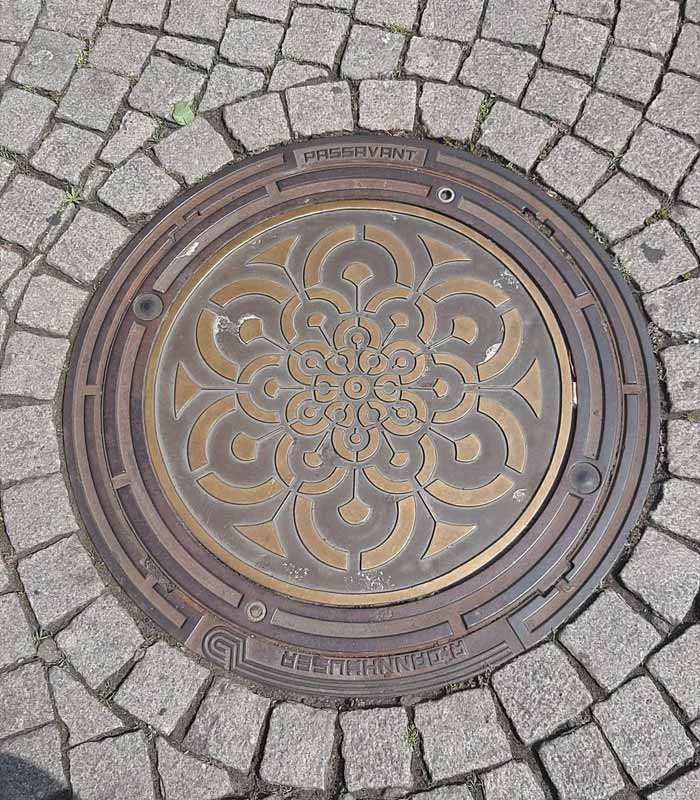
The first dimension buyers usually ask about is diameter, but a complete manhole cover assembly has several separate measurements.
For a round cover, the most important dimensions usually include:
- clear opening diameter;
- cover diameter;
- external frame diameter;
- overall frame height;
- seating or insertion depth;
- bearing width;
- cover thickness.
These dimensions serve different purposes.
The clear opening determines the usable access space into the underground chamber. The cover diameter determines how the removable lid interfaces with the frame. The external frame diameter affects how much space is required during installation, while frame depth influences how the assembly integrates with concrete, asphalt, paving, or another surrounding surface.
This is why specifications such as “600 mm manhole cover” can be incomplete. One supplier may use 600 mm to describe the clear opening while another may use it to describe the external cover diameter.
Before comparing products, buyers should therefore confirm exactly which measurement the stated size refers to.
Shengxin Foundry’s round cast iron manhole cover range currently includes in-stock diameters such as φ300 mm, φ400 mm, φ500 mm, φ600 mm, φ700 mm, φ800 mm, φ900 mm, and φ1000 mm, while customized dimensions can also be produced for project requirements.
Understanding the Main Manhole Cover Dimensions
A professional specification should describe the complete cover-and-frame geometry rather than relying on one number.
| Dimension | What It Describes | Why It Matters |
|---|---|---|
| Clear opening | Usable opening inside the frame | Determines maintenance access |
| Cover diameter | Diameter of the removable cover | Ensures correct frame fit |
| External frame diameter | Overall outside dimension | Determines installation space |
| Frame height | Vertical depth of the frame | Affects pavement integration |
| Seating depth | Contact depth between cover and frame | Influences stability |
| Bearing width | Structural support area | Influences load distribution |
| Cover thickness | Structural section depth | Contributes to load performance |
For engineering procurement, these dimensions should ideally appear on a technical drawing or approved specification sheet.
What Is a Standard Manhole Cover Size?
There is no single universal manhole cover size that fits every project worldwide.
Dimensions vary according to:
- local infrastructure standards;
- chamber design;
- utility type;
- maintenance access requirements;
- road construction practices;
- manufacturer design;
- load class.
Round manhole covers commonly appear in nominal ranges from approximately 300 mm to 1000 mm or more, but the exact size should always follow the chamber design rather than an assumed “standard.”
Shengxin Foundry currently lists round cast iron cover sizes from φ300 mm through φ1000 mm and supports customized dimensions when a project requires a different geometry.
For buyers, this means “standard size” should usually be interpreted as a manufacturer’s established production size rather than a guarantee that the same dimensions will fit every existing chamber.
Why 600 mm Is Common but Not Universal
A 600 mm access opening is frequently encountered in sewer, drainage, utility, and inspection applications because it can provide practical maintenance access while keeping the cover reasonably compact.
However, assuming every “600 mm manhole cover” is interchangeable can create installation problems.
A 600 mm designation might refer to:
- 600 mm clear opening;
- 600 mm cover diameter;
- 600 mm nominal chamber size.
The frame itself will typically be larger than the opening.
Therefore, when replacing an existing cover, buyers should measure both the chamber and the current frame rather than ordering solely according to the visible cover diameter.
Round Manhole Cover Sizes for Different Applications
Different underground systems may require different access dimensions.
Small Utility Chambers
Smaller diameters may be suitable for restricted-access infrastructure such as certain utility inspection points, landscape drainage systems, or specialized chambers.
Municipal Sewer and Drainage Chambers
Medium-size covers are commonly used where technicians need regular access for inspection, cleaning, or maintenance.
Large Infrastructure Chambers
Larger covers may be required for chambers containing valves, pipelines, cable infrastructure, or equipment requiring greater access space.
The most appropriate size should therefore be determined by the chamber function rather than by traffic loading alone.
A larger diameter does not automatically mean a higher load rating.
Size and Load Rating Are Separate Specifications
This distinction is particularly important.
A manhole cover may be physically large but designed only for moderate loads. Another cover with a smaller diameter may be engineered for substantially heavier traffic.
Load performance depends on factors such as:
- material grade;
- cover geometry;
- rib structure;
- wall thickness;
- frame design;
- bearing area;
- casting quality;
- connection between cover and frame.
Therefore, buyers should never infer load capacity from size or weight alone.
Shengxin Foundry’s cast iron product range includes load-bearing grades from A15 through F900 depending on the cover design and project requirement.
Understanding Manhole Cover Load Classes
For projects using EN 124-style classification, access covers and gratings are divided into load classes according to the installation environment and required test load.
A practical overview is shown below.
| Load Class | Nominal Test Load | Typical Application |
|---|---|---|
| A15 | 15 kN | Pedestrian or similar light-duty areas |
| B125 | 125 kN | Footways, pedestrian areas, some parking zones |
| C250 | 250 kN | Kerbside and selected roadside drainage areas |
| D400 | 400 kN | Road carriageways and regular vehicle traffic |
| E600 | 600 kN | Heavy industrial areas and terminals |
| F900 | 900 kN | Extremely demanding areas such as certain airports or ports |
The correct class depends primarily on where the product is installed, not simply on the maximum vehicle weight expected at the site.
For projects governed by EN 124 or another local standard, engineers should confirm the applicable edition and project specification before finalizing the product.
A15: Light-Duty Areas
A15-class products are generally associated with locations exposed mainly to pedestrians or similarly light loads.
Examples may include:
- gardens;
- landscaped areas;
- pedestrian-only locations;
- selected low-load utility access points.
They should not be selected for normal road traffic merely because the cover dimensions match the chamber.
B125: Pedestrian and Parking Applications

B125 products may be used in areas such as:
- pedestrian zones;
- footways;
- certain car parking areas;
- light-duty access locations.
Traffic conditions still need to be evaluated carefully because parking areas can contain delivery vehicles or service vehicles that create higher loads than expected.
C250: Kerb and Roadside Areas
C250 products are generally associated with kerbside or similar locations where covers may encounter greater vehicle loading than pedestrian areas but are not positioned directly within the primary traffic lane.
For drainage projects, location is especially important because a grate near the kerb may experience very different wheel loading from one installed directly in the carriageway.
D400: Road Carriageways
D400 is one of the most important classifications for municipal road infrastructure.
These covers are commonly considered for locations exposed to regular vehicle traffic, such as:
- urban roads;
- commercial roads;
- truck access routes;
- municipal infrastructure;
- certain industrial roads.
Shengxin Foundry lists D400 ductile iron manhole covers among its infrastructure applications, including a municipal drainage project in Ghana.
E600: Heavy Industrial Environments
E600 covers may be required where infrastructure experiences substantially heavier operational loads.
Potential applications include:
- industrial yards;
- logistics facilities;
- terminal areas;
- heavy equipment routes;
- manufacturing sites.
In such environments, engineers should also consider repeated loading, vibration, pavement condition, and frame support.
F900: Extreme Heavy-Duty Applications
F900 represents the highest class in the commonly used A15–F900 sequence.
This category may be specified for highly demanding environments such as:
- selected airport areas;
- port facilities;
- container terminals;
- extremely heavy industrial operations.
Selecting F900 should be based on engineering requirements rather than simply choosing the highest available rating.
Overspecification can increase material use, weight, handling complexity, and project cost without providing meaningful additional value where lower classes already meet the requirement.
How Installation Location Determines the Correct Load Class
One of the most useful ways to select a manhole cover is to begin with the location rather than the product catalog.
Consider three covers of identical diameter.
The first is installed in a landscaped pedestrian area. The second is installed in a commercial parking lot. The third is positioned directly in a truck traffic lane.
Although all three covers may have the same dimensions, their loading conditions are completely different.
The appropriate specification must therefore consider:
- whether vehicle wheels can pass directly over the cover;
- type of vehicles;
- traffic frequency;
- potential dynamic impact;
- surrounding pavement condition;
- emergency or maintenance vehicle access.
This location-first approach reduces the risk of selecting a technically unsuitable cover.
Why Vehicle Weight Alone Is Not Enough
A frequent purchasing mistake is asking something like:
“Can this cover support a 40-ton truck?”
The question seems reasonable, but vehicle gross weight alone does not describe the load applied to a manhole cover.
A vehicle’s total weight is distributed across multiple axles and wheels. The actual force applied to the cover depends on:
- axle loading;
- wheel position;
- tire contact area;
- dynamic movement;
- vehicle speed;
- road surface condition.
A wheel striking a slightly raised or poorly seated cover can also create dynamic impact greater than a slow static loading condition.
For this reason, standardized load classes and engineering specifications provide a more reliable basis for product selection than vehicle gross weight alone.
Manhole Cover Weight vs Load Capacity
Your keyword research also includes manhole cover weight, which reflects another common buyer concern.
Weight matters, but it should not be confused with load capacity.
A heavier cover may contain more metal, but this does not automatically mean it has a superior structural design.
Load capacity depends on how the material is distributed through the cover and frame.
Two covers with similar weight can perform differently because of variations in:
- reinforcing rib geometry;
- material grade;
- casting quality;
- frame support;
- thickness distribution.
Similarly, modern ductile iron design can sometimes achieve strong performance without relying solely on increasing mass.
Shengxin Foundry notes that product weight varies by size and model and provides weight information according to specific customer requirements.
Why the Frame Matters as Much as the Cover
The cover itself does not carry traffic loads independently.
When a wheel passes over the system, force travels through the cover into the frame and then into the surrounding chamber or pavement structure.
The load path can be simplified as:
Vehicle → Cover → Frame → Bedding → Chamber Structure
If any one of these elements performs poorly, the complete installation may develop problems even when the cover itself has adequate strength.
For example, a strong D400 cover installed on a poorly supported frame may experience:
- rocking;
- localized stress;
- excessive noise;
- pavement cracking;
- frame movement;
- premature wear.
For a more detailed explanation of this interaction, Shengxin Foundry’s article on cast iron manhole frame and cover systems explains why the cover and supporting frame should be treated as one structural assembly.
Clear Opening vs External Frame Size
Another frequent source of procurement errors is confusing the clear opening with overall dimensions.
Imagine a specification stating:
Clear opening: 600 mm
This does not mean the complete frame is 600 mm wide.
The external frame diameter may be considerably larger because it must provide:
- a seating surface for the cover;
- sufficient structural width;
- space for anchoring or bedding;
- adequate load transfer.
Therefore, technical drawings should ideally show at least three dimensions:
- clear opening;
- cover diameter;
- external frame diameter.
Without these details, replacement projects are particularly vulnerable to size mismatch.
Measuring an Existing Manhole Before Ordering
When replacing an existing cover, avoid measuring only the damaged lid.
If possible, measure the complete installation.
Important dimensions include:
| Measurement | Recommended Check |
|---|---|
| Clear opening | Measure internal chamber/frame opening |
| Cover diameter | Measure actual removable lid |
| Frame outside diameter | Measure full external frame |
| Frame depth | Measure vertical installation height |
| Seating depth | Check cover engagement with frame |
| Existing cover thickness | Useful reference but not sole specification |
| Shape | Round, square or rectangular |
Photographs and technical drawings are also valuable when sourcing customized replacements.
For older infrastructure, existing dimensions may no longer correspond perfectly to current catalog standards, making customization necessary.
Why Round Manhole Covers Are Common
Round manhole covers remain widespread in sewer, drainage, and municipal infrastructure.
One practical advantage is geometric safety: a properly designed circular cover cannot fall through a circular opening of smaller diameter regardless of its orientation.
Round covers are also easy to rotate during installation and maintenance because they do not require alignment with specific corners.
Their circular frame geometry can distribute loads around the circumference, although actual structural performance still depends on material, rib design, frame geometry, and installation quality.
Shengxin Foundry’s cast iron round manhole cover uses QT500-7 spheroidal graphite cast iron and is offered with multiple size and load-class options for municipal, residential, parking, roadway, and utility applications.
When a Square Manhole Cover May Be More Suitable
Round designs are not always the preferred geometry.
Square and rectangular covers can be appropriate where:
- the chamber itself is rectangular;
- access equipment requires a wider opening;
- the surrounding paving follows a grid;
- utility layouts favor rectangular access;
- multiple cover units are arranged together.
The decision should therefore be based on chamber geometry and maintenance requirements rather than assuming round covers are always superior.
Material Choice Also Influences Size and Structural Design
The same nominal opening can be covered by products made from different materials, including ductile iron and composite resin.
However, the structural geometry may not be identical because the mechanical properties of the materials differ.
A ductile iron cover may rely on:
- metallic section thickness;
- rib reinforcement;
- frame contact;
- nodular graphite iron properties.
A composite cover may rely on:
- resin formulation;
- reinforcement;
- molded geometry;
- fiber distribution.
Therefore, a buyer replacing one material with another should not assume that identical external dimensions automatically mean equivalent structural performance.
Shengxin Foundry supplies both ductile iron and composite resin solutions through its manhole cover product center, allowing material, dimensions, shape, and load class to be selected according to project conditions.
How Surface Conditions Affect Load Performance
The same cover can experience different real-world stress depending on how it is installed relative to the surrounding pavement.
A flush installation allows vehicle wheels to pass smoothly across the cover.
A cover that sits above or below the surrounding pavement can create additional impact.
Common causes include:
- pavement settlement;
- incorrect frame height;
- poor installation;
- deterioration of bedding material;
- repeated road resurfacing.
This is why long-term cover performance depends not only on the specified load class but also on maintaining the surrounding road structure.
Noise, Rocking and Incorrect Fit
A manhole cover that moves when vehicles pass over it may indicate a dimensional or seating problem.
Common causes include:
- excessive clearance;
- uneven frame seating;
- debris between cover and frame;
- damaged contact surfaces;
- frame deformation;
- pavement settlement.
A heavier cover may reduce movement in some cases, but adding weight is not a complete engineering solution.
Correct dimensional tolerance and stable seating are more important.
The round cast iron cover offered by Shengxin Foundry includes a rubber shock-absorbing ring as part of the available structure, which can help address cover-to-frame impact and operating noise when correctly specified and installed.
Why Anti-Slip Design Should Be Included in the Specification
Load class and dimensions are critical, but surface safety should not be overlooked.
A road or pedestrian cover can become slippery when exposed to:
- rainfall;
- mud;
- oil;
- snow;
- drainage water.
Raised surface patterns help improve grip between the cover and vehicle tires or footwear.
For traffic applications, anti-slip performance should therefore be considered together with:
- load class;
- material;
- surface coating;
- drainage;
- expected pedestrian use.
How International Buyers Should Write a Manhole Cover Specification
A clear purchasing specification reduces back-and-forth communication and decreases the possibility of receiving an unsuitable product.
Instead of writing:
Need 600 mm heavy manhole cover.
A more useful specification would include:
Round ductile iron manhole cover and frame, 600 mm clear opening, D400 load class, for municipal road installation, anti-slip surface, noise-reduction requirement, dimensions to be confirmed by drawing.
This immediately gives the manufacturer several important engineering parameters.
For international infrastructure projects, buyers should ideally provide:
- product material;
- shape;
- clear opening;
- frame dimensions;
- required load class;
- installation location;
- applicable standard;
- surface treatment;
- locking requirement;
- anti-slip requirement;
- project quantity;
- technical drawing where available.
Do Not Select a Manhole Cover by Weight Alone
The keyword “manhole cover weight” attracts significant search interest because buyers often use weight as a simple way to judge whether a product is heavy duty.
However, weight is only one physical characteristic.
Consider two ductile iron covers.
Cover A uses a poorly optimized flat structure and weighs 90 kg.
Cover B uses optimized reinforcement ribs, better frame support, and weighs 80 kg.
It is entirely possible for Cover B to provide comparable or better structural performance depending on material grade, design, and testing.
Therefore, a professional purchasing decision should prioritize verified load performance and appropriate classification rather than assuming:
heavier cover = stronger cover
Common Manhole Cover Sizing Mistakes
Several recurring mistakes can create installation delays or long-term performance problems.
Ordering by Visible Diameter Only
The visible top diameter may not represent the clear opening or complete frame size.
Ignoring Existing Frame Dimensions
Replacement covers must fit the existing frame unless the frame is being replaced as well.
Mixing Nominal and Actual Dimensions
A product name may use nominal dimensions that differ slightly from measured physical dimensions.
Selecting Load Class Based Only on Size
Diameter and load capacity are separate specifications.
Ignoring Frame Height
Incorrect frame depth can create problems when matching pavement elevation.
Assuming Every Country Uses the Same Standard
Infrastructure standards differ between regions, municipalities, and project authorities.
A Practical Selection Matrix
The following simplified matrix can help buyers organize the first stage of product selection.
| Application | Typical Design Priority | Possible Load Range |
|---|---|---|
| Landscape area | Light load, corrosion resistance | A15 |
| Pedestrian zone | Safety, anti-slip surface | A15–B125 |
| Parking area | Vehicle access, stable seating | B125 or project-specific |
| Roadside / kerb | Drainage and wheel exposure | C250 |
| Urban road | Repeated vehicle loading | D400 |
| Industrial yard | Heavy vehicles and equipment | D400–E600 |
| Port / terminal | Extreme heavy loading | E600–F900 |
| Airport heavy-load zone | High structural requirement | F900 where specified |
This table is a practical starting point only. Final selection should follow the governing project specification and applicable standard.
What Buyers Should Confirm Before Production
Before approving a manhole cover order, purchasing teams should perform a final technical review.
Confirm:
- Is the stated dimension the clear opening or cover diameter?
- Does the frame fit the chamber?
- Is the load class suitable for the actual installation zone?
- Has vehicle traffic been considered?
- Is the material grade specified?
- Are surface and anti-slip requirements defined?
- Is locking required?
- Does the cover need a rubber or cushioning system?
- Is a custom logo or marking required?
- Has the technical drawing been approved?
These questions can prevent many of the most common procurement errors.
Custom Sizes for Infrastructure Projects
Not every project can use standard catalog dimensions.
Renovation projects, older urban infrastructure, utility upgrades, and region-specific construction systems may require customized cover geometry.
Custom options can include:
- non-standard diameter;
- special external frame dimensions;
- customized frame height;
- specific surface pattern;
- project logo;
- municipal identification;
- locking mechanism;
- special cover-and-frame structure.
Shengxin Foundry states that size, specifications, branding, color, and appearance can be customized according to project requirements. Its product range also spans A15–F900 load classes for municipal roads, industrial parks, terminals, and other applications.
Frequently Asked Questions
What are common cast iron manhole cover round sizes?
Round cast iron manhole covers are produced in many diameters. Shengxin Foundry currently lists φ300, φ400, φ500, φ600, φ700, φ800, φ900, and φ1000 mm as available sizes, with customization also supported. The correct dimension should be selected according to clear opening and frame requirements rather than nominal diameter alone.
Is 600 mm a standard manhole cover size?
600 mm is a commonly encountered size in many infrastructure projects, but it is not a universal standard for every installation. Buyers must confirm whether 600 mm refers to clear opening, cover diameter, or another dimension.
Does a heavier manhole cover have a higher load rating?
Not necessarily. Load capacity depends on material, structural design, thickness distribution, reinforcement, frame geometry, and testing. Product weight alone should not be used to determine load class.
What load class is normally used for roads?
D400 is commonly associated with road carriageway applications under EN 124-style classification. However, the exact class should always follow the project’s applicable standard and installation location.
What measurements are needed when replacing an existing manhole cover?
Measure the clear opening, cover diameter, external frame dimensions, frame depth, seating area, and overall shape. Supplying photographs and drawings can also help manufacturers verify compatibility.
Conclusion
Selecting the correct manhole cover requires more than finding a diameter that matches an underground opening. Cast iron manhole cover round sizes, clear opening dimensions, external frame dimensions, load class, material, traffic conditions, and installation geometry must all work together.
A cover that fits physically but has the wrong load class may create a safety problem. A cover with the correct load class but an incompatible frame may rock, generate noise, or transfer loads incorrectly. Likewise, choosing a product simply because it is heavier does not guarantee better structural performance.
For procurement teams, the most reliable approach is to define the installation location first, determine the applicable load class, confirm clear opening and frame dimensions, and then approve the complete cover-and-frame specification.
Shengxin Foundry provides round ductile cast iron manhole covers in multiple standard diameters and supports customized size and load-class requirements for municipal, industrial, drainage, roadway, and utility infrastructure projects. For non-standard dimensions or project-specific specifications, buyers can contact Shengxin Foundry with chamber drawings, required load class, and installation information for technical matching.